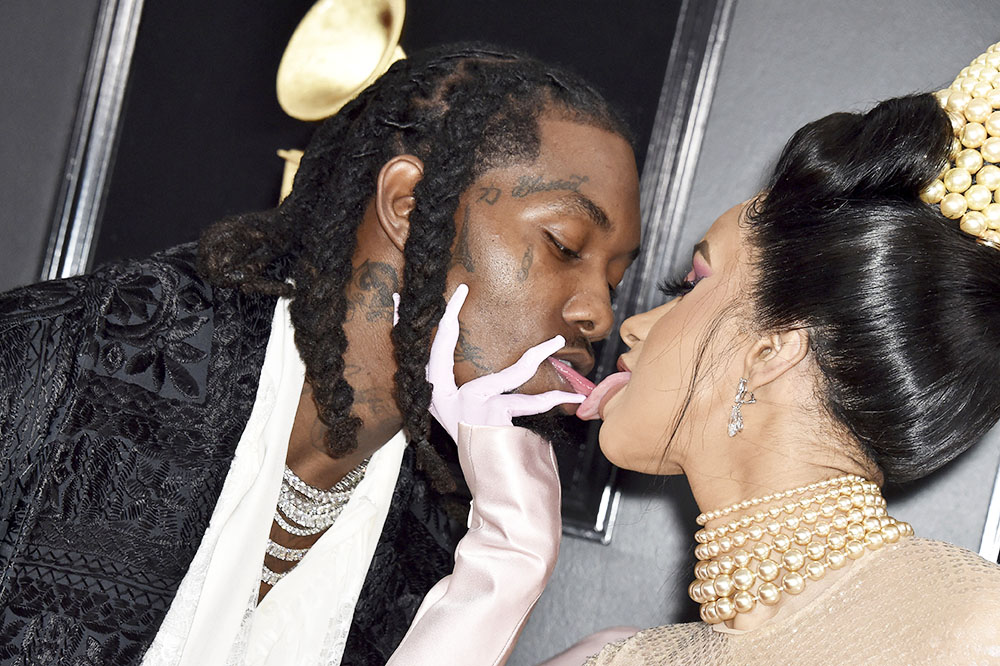
Offset Felt ‘Saved’ When Cardi B Called Off Divorce

After Offset thought his marriage with Cardi B was over — following her divorce filing to ‘teach him a lesson’ — the Migos rapper stepped up to the plate in their relationship. HollywoodLife has learned that he’s acting like a changed man, and Cardi loves it!


Cardi B & Offset
AP
Offset,Cardi B
Cardi B,Offset
Cardi B Files For Divorce From Rapper Offset
Cardi B,Offset

And all it took was filing for divorce.  Offset has been on his best behavior Cardi B after she actually went through with filing  court documents to end their marriage back in September. The Grammy-winner, 28, later admitted that the divorce filing was only to teach Offset a lesson  after they had been constantly arguing . On November 2, she filed  new legal documents to dismiss her initial divorce filing. Although they’re  back together , the whole ordeal had a significant impact on Offset — for the better.

“Offset has been spending the majority of his time with Cardi and when he’s not with her he’s always in contact — he never misses her calls. You can tell he’s not trying to do anything to upset her,” a source close to the father of four told HollywoodLife, exclusively. ‘He was so crushed when Cardi filed for divorce, so when she took him back and called it off, he felt saved. But, he knows that the next time he might not be so lucky to get another chance, so he doesn’t want to mess this up and that’s very evident,” the insider explained, adding, “Offset loves her so much and ever since she took him back he’s been much happier and he never wants to lose her again.”

“He got a scare when she filed for divorce and knew he had to step up,” a second source close to Offset said, noting that the “MotorSport” rapper is on his “best behavior.” While Cardi and Offset have had their fair share of highs and lows, “he can’t see himself with anyone else,” the insider admits. “He really is doing his best to be there for Cardi because he loves being a family with her. Things are going very well right now, and he’s looking forward to the holidays with Cardi and Kulture.

Cardi previously admitted that she had zero intentions of her divorce filing to go public. However, it did. News of her September 15 divorce filing in Georgia, where the couple has a home together, was the first of a series of wild events that would go on between the rappers. Despite the split, Cardi went on to spend her 28th birthday with Offset in Las Vegas, and then later in Atlanta for other events with friends. Fans eventually assumed the two were back together after Cardi continued to share social media posts with and about Offset.

Source:hollywoodlife.com


Comments

Popular posts from this blog

The Latest Aso Ebi Styles -Vol. 279

Reviewed by the BabyCenter Medical Advisory Board Updated April 2017 IN THIS ARTICLE Ovulation problems Endometriosis Poor egg quality Polycystic ovarian syndrome Tubal factors Unexplained fertility problems Eleven percent of reproductive-age couples in the United States have trouble conceiving or sustaining a pregnancy. About one-third of these cases are due to female fertility problems, one-third to male fertility problems, and the rest to factors involving both partners or to unexplained causes. If you've had regular, unprotected sex for more than a year without conceiving (or six months if you're older than 35), see your doctor. About 65 percent of couples that get treatment for a fertility problem are eventually able to have a successful pregnancy, according to Resolve, the national infertility association. The success rates below are based on averages gathered from large groups of patients. Each couple is unique, so think of the success rate for any treatment as a general snapshot, not a prediction of your chances of having a baby. Read on to learn more about female infertility and available fertility treatments. Ovulation problems An ovulation problem occurs when eggs don't mature in the ovaries or when the ovaries fail to release a mature egg. This is sometimes known as premature ovarian failure. Ovulation problems are common in women with infertility. Possible symptoms: Absent or infrequent periods, unusually light or heavy menstrual bleeding, or lack of such premenstrual symptoms as bloating or breast tenderness. Possible solutions: Managing body weight if it's too low or too high, taking fertility drugs (with or without artificial insemination), and having in vitro fertilization (IVF). Success rates: Thirty to 40 percent of women taking clomiphene citrate to induce ovulation become pregnant by the third treatment cycle. When fertility drugs to increase egg production are combined with artificial insemination, the pregnancy rate is between 10 and 20 percent per treatment cycle. The percentage of IVF treatment cycles resulting in a live birth (in which one or more babies are born) is about: 40 percent for women age 34 and under 31 percent for women age 35 to 37 21 percent for women age 38 to 40 11 percent for women age 41 to 42 5 percent for women age 43 and over Endometriosis Endometriosis is a condition that occurs when tissue normally found in the lining of the uterus (endometrial tissue) grows outside the uterus, usually in the abdomen or pelvis. Possible symptoms: Some women have no symptoms, while others have painful periods or intercourse, heavy bleeding or unusual spotting, and general pelvic pain. advertisement | page continues below Possible solutions: Surgery to remove endometrial tissue or open blocked fallopian tubes, fertility drugs (with or without artificial insemination), and IVF. Success rates: A large study found that 30 percent of women with infertility related to early stage endometriosis conceived naturally within three years after having laparoscopic surgery to remove endometrial tissue. When women with early stage endometriosis are treated with fertility drugs and artificial insemination, the pregnancy rate is between 9 and 15 percent per treatment cycle. The live birth rate per treatment cycle for women with endometriosis who undergo IVF ranges from 2 to 42 percent, depending on the woman's age. Poor egg quality The quality and number of eggs the ovaries produce – naturally or with fertility treatment – declines significantly after age 35. Possible symptoms: None. advertisement | page continues below Possible solutions: Fertility drugs, IVF using your own eggs, IVF with donor eggs or donor embryos. Success rates: Women who have IVF using donor eggs have an approximate 55 percent chance of having a baby per IVF cycle. Polycystic ovarian syndrome Polycystic ovarian syndrome (PCOS) is a condition in which small follicles in the ovaries don't develop into the larger, mature follicles that release eggs. It's also characterized by hormone imbalances and unpredictable ovulation patterns. Possible symptoms: irregular periods, excessive hair growth, acne, and obesity. Possible solutions: Lifestyle modifications (like diet and exercise), clomiphene citrate, injected fertility drugs, ovarian drilling (a surgical procedure that can trigger ovulation), and IVF. In women with glucose intolerance, the diabetes drug metformin (Glucophage) can also help restore regular ovulation. advertisement | page continues below Success rates: Many overweight patients who lose 5 to 10 percent of their body weight start ovulating regularly. For women with PCOS who take clomiphene citrate, the pregnancy rate per treatment cycle is about 18 percent. For women treated with ovarian drilling, about 50 percent get pregnant within one year. Tubal factors Blocked or damaged fallopian tubes prevent sperm from getting to your egg and also prevent the fertilized egg from getting to your uterus. Leading causes of tube problems include pelvic inflammatory disease, sexually transmitted infections (such as chlamydia), and previous sterilization surgery. Possible symptoms: None. Possible solutions: Surgery to open the tubes. If surgery fails, or if the tubes are too damaged to repair, they may be removed before having IVF in order to improve your chances of pregnancy. Success rates: Conception rates after surgery vary widely, depending on the location and severity of the tube blockage and the amount of postoperative scar tissue that develops. advertisement | page continues below Couples with tubal factor infertility who try IVF have a 22 percent chance on average of having a baby per IVF treatment cycle. This depends on the woman's age, extent of tubal disease or whether the tubes have been removed, and several other factors. Unexplained fertility problems Your doctor may diagnose an unexplained fertility problem if there's no obvious reason for your infertility (meaning all test results are normal). Some experts believe subtle differences in the way the reproductive system works may cause this type of infertility. This can include differences in follicle development, sperm function, or the fertilization process. Experts also theorize that lifestyle factors – such as being significantly underweight or overweight, regularly consuming too much caffeine or alcohol, and smoking – may be contributing factors as well. Possible symptoms: None. advertisement | page continues below Possible solutions: Fertility drugs (with or without artificial insemination) or IVF. Success rates: For couples with unexplained infertility, the pregnancy rate is between 9 and 26 percent per treatment cycle when fertility drugs are used in combination with artificial insemination. With IVF, the live birth rate is about 30 percent per treatment cycle, but that figure varies depending on age.